
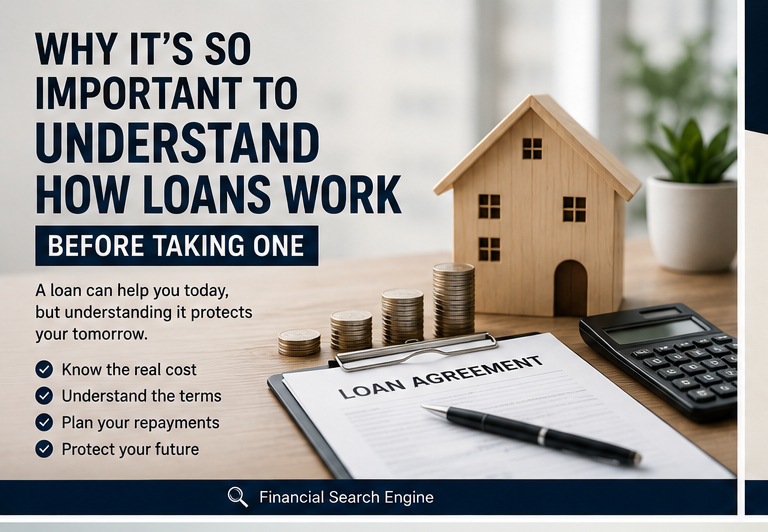
Why It’s So Important to Understand How Loans Work Before Taking One
Borrowing money is easy — understanding the deal is what protects you. Interest, fees, loan terms and total repayment all decide what a loan really costs, and why a lower monthly payment isn’t always the better option.
There is something very easy about borrowing money.
You need something. You don't have enough money to pay for it today. A lender offers you the money, you make regular payments, and eventually the loan is paid off.
Simple, right?
Not always.
A loan can solve an immediate financial problem while creating a much bigger one if you don't understand what you're actually agreeing to.
The amount you borrow is only part of the story.
You also need to understand the interest, fees, repayment period, monthly payments, penalties, conditions and, most importantly, the total amount of money you will eventually pay back.
Because a loan isn't free money.
It is money you are using today in exchange for a commitment to repay more money over time.
Understanding that commitment before signing anything can make an enormous difference to your financial future.
A Loan Is More Than the Amount You Borrow
Imagine you need $10,000 and a lender agrees to give you the full amount.
At first, it might feel like you have $10,000 available.
But you haven't really received $10,000 without conditions.
You've received $10,000 that you are obligated to repay according to the terms of the loan.
Depending on the loan, you may also have to pay interest and various fees.
That means the real question isn't:
"How much can I borrow?"
A better question is:
"How much will this loan actually cost me from beginning to end?"
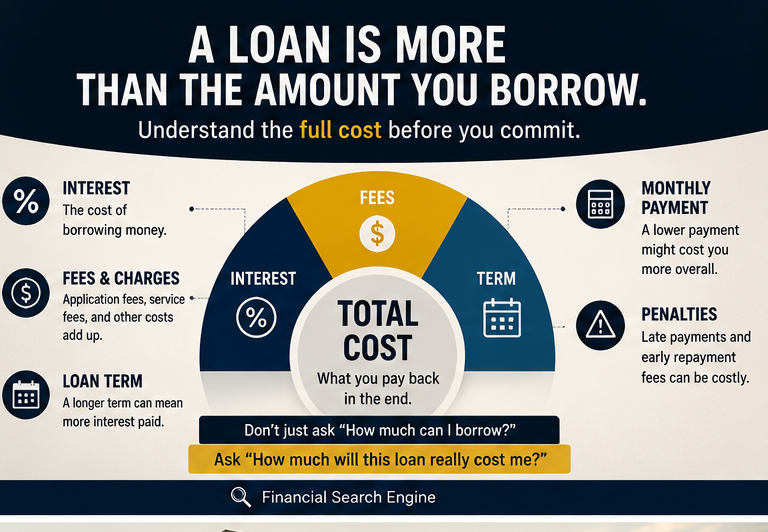
That second question can completely change how you look at borrowing.
A loan that appears affordable because of its monthly payment may become considerably more expensive when you calculate the total repayment.
Interest Is One of the Most Important Things to Understand
Interest is essentially the cost of borrowing money.
A lender provides you with money today, and interest is one of the ways the lender earns money for providing that service.
The interest rate can therefore have a major impact on the cost of a loan.
Two people could borrow the same amount of money but pay very different amounts overall because their interest rates, loan terms or fees are different.
This is why simply looking at the amount you receive isn't enough.
You need to understand the interest rate and how it applies to the balance.
A Lower Monthly Payment Isn't Always a Better Deal
This is one of the easiest traps to fall into.
Imagine two loans.
One has a relatively high monthly payment but can be paid off quickly.
The other has a much lower monthly payment but lasts several years longer.
At first glance, the second loan may appear more affordable.
And from a monthly cash-flow perspective, it might be easier to manage.
But stretching a loan over a longer period can mean paying interest for much longer.
You could therefore end up paying significantly more overall.
This is why you shouldn't judge a loan solely by asking:
"Can I afford the monthly payment?"
Also ask:
"How much will I pay altogether?"
Both numbers matter.
The Loan Term Matters
The loan term is the amount of time you have to repay the loan.
A shorter term generally means fewer payments and potentially less interest paid over the life of the loan, although the monthly payments may be higher.
A longer term can reduce the monthly payment but potentially increase the total amount of interest you pay.
There isn't automatically one correct loan term for everyone.
The important thing is understanding the trade-off.
A lower monthly payment can sometimes come with a higher overall cost.
That is why the phrase "affordable every month" shouldn't automatically be interpreted as "affordable overall."
Fees Can Change the Real Cost
Interest isn't necessarily the only cost associated with borrowing.
Depending on the lender and type of loan, there may be application fees, origination fees, service charges, late-payment fees, early-repayment conditions or other costs.
Some fees may be obvious.
Others may be buried in the loan documentation.
This is why reading the terms before accepting a loan matters.
Don't be afraid to ask:
- What fees will I pay?
- When are those fees charged?
- Are there penalties for late payments?
- Are there charges for paying the loan early?
- Can the interest rate change?
- What happens if I miss a payment?
- Is there collateral involved?
- What happens if I cannot repay the loan?
These aren't unnecessary questions.
They are questions that can help you understand what you're agreeing to.
Fixed and Variable Interest Rates Can Work Differently
Not every loan necessarily behaves the same way.
Some loans may have a fixed interest rate, meaning the rate remains unchanged for a specified period or throughout the loan, depending on the agreement.
Others may have a variable or adjustable rate that can change under certain conditions.
That difference can matter significantly.
If your interest rate can change, your future payments may also change.
Before accepting a loan with a variable rate, you should understand what causes the rate to change and how that could affect your payments.
Never assume that the payment you see today will necessarily remain the same forever.
Borrowing Can Affect Your Future Income
One of the most important things to remember is that a loan doesn't just affect your finances today.
It affects future income.
Suppose you earn money every month.
Before taking a loan, a portion of that future income may be available for groceries, savings, transportation, entertainment, emergencies and other goals.
After taking the loan, part of that future income is already committed.
That's an important concept.
When you borrow money, you're effectively making a commitment against some of your future financial flexibility.
The more debt you take on, the more of your future income may already have somewhere to go.
Just Because You Qualify Doesn't Mean You Can Afford It
A lender approving your application doesn't necessarily mean the loan is financially comfortable for you.
Lenders use their own criteria to assess whether they are willing to lend money.
Your personal financial situation may tell a different story.
You might technically qualify for a larger loan but find that the monthly payment leaves very little room for everything else.
This is why you should determine your own affordable borrowing limit rather than simply borrowing the maximum amount someone is willing to offer.
Ask yourself:
"If my income stayed the same, could I comfortably make this payment every month?"
Then ask an even harder question:
"What happens if something goes wrong?"
What if your expenses increase?
What if your income decreases?
What if you have an unexpected emergency?
What if another financial responsibility appears?
A loan should ideally leave you with some room to handle life.
Emergency Expenses Don't Stop Because You Have Debt
Life doesn't follow a budget perfectly.
Cars break down.
Appliances stop working.
People experience unexpected expenses.
Income can change.
Family responsibilities can appear unexpectedly.
If nearly all of your available income is already committed to debt payments, an unexpected expense can quickly become another borrowing problem.
This can create a dangerous cycle.
You borrow to solve one problem.
Then you need to borrow again to solve another.
Eventually, debt payments can start competing with basic living expenses.
Understanding how much financial breathing room you have before taking a loan can help you avoid becoming overly dependent on borrowing.
Debt Can Be Useful When Used Carefully
It's important not to treat all borrowing as automatically bad.
Loans can serve useful purposes.
People may borrow to purchase homes, fund education, start businesses, purchase vehicles, manage major expenses or achieve other long-term goals.
The important distinction is whether the borrowing makes sense within the person's broader financial situation.
A loan can be a useful financial tool when you understand its cost and have a realistic plan for repayment.
The problem begins when borrowing becomes something you use without understanding the consequences.
Don't Borrow Just Because You Can
Modern financial services can make borrowing feel incredibly easy.
You can sometimes apply online, receive decisions quickly and have money available without much delay.
That convenience can be helpful.
But it can also make it easier to make emotional decisions.
You see something you want.
You don't have enough money right now.
A loan appears to solve the problem.
Suddenly, the purchase feels affordable.
But the purchase hasn't actually become cheaper.
You've simply moved the payment into the future and added the cost of borrowing.
Before taking the loan, ask yourself:
"Would I still want this if I had to pay the full price today?"
And then ask:
"Is borrowing the right financial decision, or am I simply trying to make something I cannot currently afford feel affordable?"
Those questions can be surprisingly powerful.
Compare Loans Before Choosing One
One of the biggest mistakes borrowers make is accepting the first loan they qualify for.
Different lenders may offer different rates, fees, repayment periods and conditions.
Comparing options can therefore be valuable.
Don't compare only the advertised interest rate.
Look at the broader cost.
Consider:
- Interest rate
- Total repayment amount
- Loan term
- Monthly payment
- Fees
- Penalties
- Rate conditions
- Early repayment rules
- Other contractual obligations
A loan calculator can also help you understand how changing the amount borrowed, interest rate or repayment period could affect the overall cost.
Sometimes changing one variable can make a surprisingly large difference.
Understand the Difference Between "Need" and "Want"
This doesn't mean you should never borrow money for something you want.
It means you should be honest with yourself.
If you are borrowing because you genuinely need something, the decision may require a different level of consideration than borrowing for an impulse purchase.
Before taking a loan, pause.
Ask yourself:
Do I need this now?
Could I save for it instead?
Could I buy a less expensive alternative?
Could I wait?
Will this purchase still matter to me months from now?
Sometimes waiting can be one of the most effective financial decisions you make.
Read the Agreement Before Signing It
This might sound obvious, but it is incredibly important.
Don't sign a loan agreement simply because someone has told you that the terms are standard.
Read it.
If there is something you don't understand, ask.
If you don't understand a fee, ask.
If you don't understand how the interest works, ask.
If you don't understand what happens when you miss a payment, ask.
Financial documents can contain complicated terminology, but that doesn't mean you should accept something you don't understand.
You have the right to seek clarification before committing yourself.
Be Careful With High-Cost Short-Term Loans
Short-term loans can sometimes appear attractive because the amount borrowed is relatively small and repayment happens quickly.
But some forms of short-term borrowing can carry very high costs.
The shorter repayment period can also create pressure.
A person might take one loan to cover an immediate expense, only to discover that the repayment itself creates another financial problem.
If you are considering expensive short-term borrowing, pay particular attention to the total repayment cost and what happens if you cannot repay on time.
The urgency of today's problem shouldn't prevent you from considering the financial consequences of tomorrow's problem.
Your Credit History Can Matter Too
Borrowing and repayment behaviour can affect your credit profile in many countries and financial systems.
Consistently making payments according to the terms of your agreements can be part of building a positive credit history.
Missing payments or allowing debts to become seriously overdue can have negative consequences.
The exact rules vary depending on where you live and which financial system you're using, but the broader lesson is universal:
Borrowing creates responsibilities beyond the immediate transaction.
Don't Be Afraid to Use Financial Tools
Understanding loans becomes much easier when you can see the numbers.
A loan calculator can help you estimate monthly payments and total repayment under different scenarios.
A budget planner can help you determine whether the payment fits within your finances.
A comparison tool can help you examine different loan options.
Educational resources such as the finance dictionary can help explain terms you don't understand.
These tools don't make the decision for you.
They simply give you more information before you make the decision.
And better information can lead to better decisions.
The Most Important Number Isn't Always the Monthly Payment
When considering a loan, the monthly payment is important.
But don't stop there.
Look at the entire picture.
How much are you borrowing?
How much interest could you pay?
How long will you be making payments?
What fees apply?
What happens if you miss a payment?
What happens if your financial circumstances change?
How much will the loan cost you from beginning to end?
Once you understand those numbers, you can make a much more informed decision.
Borrowing Should Come With a Plan
Before taking a loan, know how you intend to repay it.
Don't simply think:
"I'll figure it out every month."
Instead, include the payment in your budget before you accept the loan.
See what your finances look like after the payment is included.
Then test the budget.
What happens if groceries become more expensive?
What happens if transportation costs increase?
What happens if you have an unexpected expense?
What happens if your income changes?
If the loan only works when everything goes perfectly, it may be worth reconsidering.
A strong financial plan should leave some room for reality.
Understanding Loans Gives You More Control
Money can become stressful when decisions feel confusing.
The more you understand about borrowing, the more control you have over those decisions.
You begin to recognize that the size of the monthly payment doesn't tell the whole story.
You understand that interest matters.
You understand that loan terms matter.
You understand that fees matter.
You understand that your future income is part of the equation.
And you become more comfortable asking questions before signing an agreement.
That knowledge can protect you from making decisions based purely on urgency.
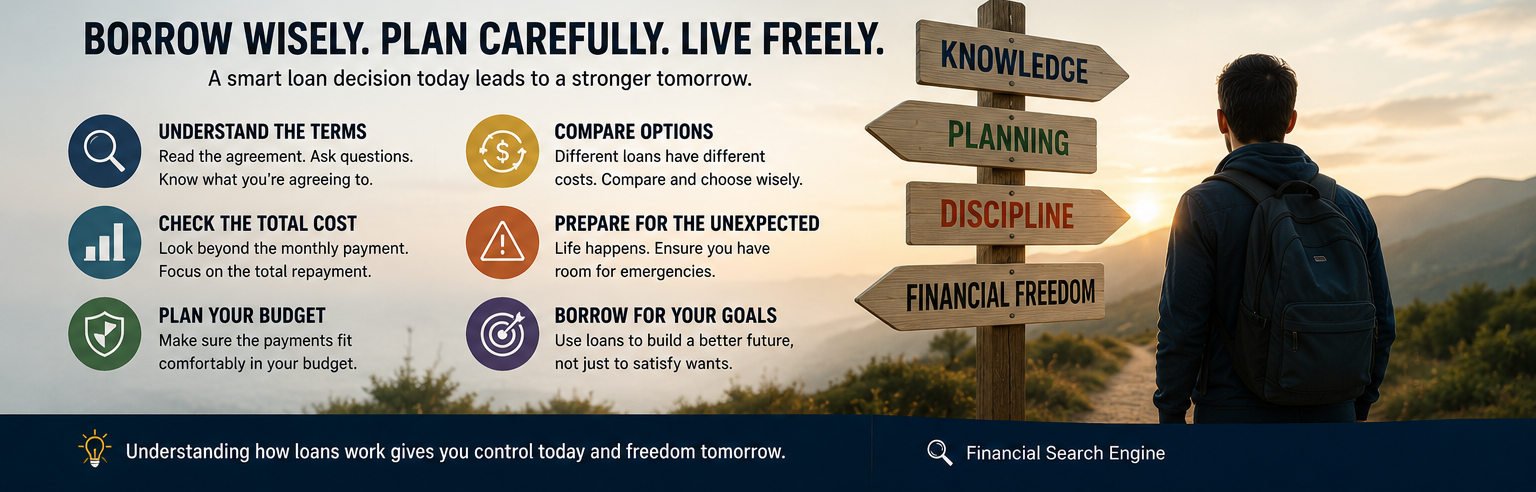
Before You Borrow, Slow Down
When you need money, slowing down can feel difficult.
You want the problem solved.
You want the money now.
You want to move forward.
But borrowing is one of those situations where taking a little extra time can be extremely valuable.
Compare your options.
Calculate the total cost.
Read the agreement.
Understand the interest.
Check the fees.
Consider your budget.
Think about what could happen if your circumstances change.
And make sure the loan solves a problem without creating a bigger one.
The Bottom Line
Loans aren't inherently good or bad.
They are financial tools.
Like any tool, they can be useful when you understand how they work and potentially harmful when you use them without understanding the consequences.
The goal isn't to avoid borrowing forever.
The goal is to borrow with your eyes open.
Before signing a loan agreement, don't just ask:
"How much money can I get?"
Ask:
"How much will this really cost me?"
"Can I comfortably afford the repayments?"
"What happens if something goes wrong?"
"Is this the best option available to me?"
And perhaps most importantly:
"Will this loan improve my financial situation, or simply postpone the problem?"
Understanding those questions won't eliminate every financial risk.
But it can help you make decisions with considerably more confidence.
Because when it comes to borrowing money, understanding the deal before you sign it may be one of the most valuable financial decisions you can make.