
Why It's Important to Think Carefully Before Using Your Assets as Collateral — And How It Could Affect Your Family
Using an asset as collateral can make borrowing possible, but it also changes what is at stake. A careful look at secured borrowing, the real cost of collateral, and how one loan decision can affect an entire household.

Publisher: Financial Search Engine · Author: Cyril N · 1 September 2026
There is something reassuring about owning an asset.
A home, a vehicle, investments, business equipment or another valuable possession can represent years of work, saving and sacrifice. So when a lender says you can use that asset as collateral for a loan, it can make borrowing seem easier.
You have something valuable.
The lender has security.
You get access to the money you need.
It can sound like a straightforward arrangement.
But there is an important detail that shouldn''t be overlooked:
The asset you''re using as collateral is now connected to the debt.
If you repay the loan according to the agreement, everything may proceed as planned. But if you fall behind and eventually default, the lender may have legal rights to take action against the collateral, depending on the loan agreement and the laws where you live.
That changes the nature of the decision.
You''re no longer simply deciding whether to borrow money.
You''re deciding whether an important asset is worth putting at risk to obtain that money.
And when that asset is something your family depends on, the consequences can extend far beyond the person who took out the loan.
What Does It Mean to Use an Asset as Collateral?
Collateral is an asset pledged to secure a loan.
The lender provides money, and the borrower agrees to repay it according to specific terms. The collateral gives the lender additional protection if the borrower fails to meet those obligations.
This is why secured loans can sometimes offer different interest rates or borrowing conditions compared with unsecured loans.
From the lender''s perspective, the loan has additional security.
From the borrower''s perspective, however, there is now something valuable at stake.
That distinction is important.
A secured loan isn''t necessarily a safer loan for the person borrowing the money. The lender may have less risk precisely because the borrower has put an asset on the line.
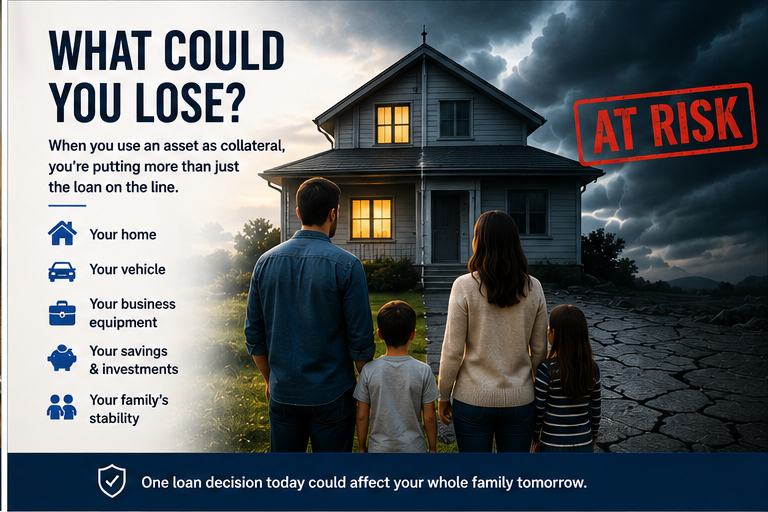
The Asset May Be Worth More Than the Loan
One of the things that can make collateral particularly risky is the difference between the value of the asset and the amount being borrowed.
Imagine someone owns a home worth $300,000 and takes out a $50,000 loan using that property as security.
The loan may represent only a fraction of the property''s value.
That can make the borrowing feel relatively harmless.
But the value of the asset doesn''t necessarily determine how comfortable the risk is.
A $50,000 financial problem could potentially put a much more valuable asset at risk.
This is why people shouldn''t think only about how much they are borrowing.
They should also think about what they are putting behind the borrowing.
Your Family Home Is More Than a Financial Asset
A house has a monetary value, but for a family it can mean much more.
It''s where children grow up.
It''s where families create memories.
It''s often connected to schools, jobs, friends, communities and everyday routines.
For many people, a home also represents years of financial progress.
Using that home as collateral therefore carries a different emotional and practical weight from using an asset that isn''t essential to everyday life.
If the loan becomes unaffordable and the property is subject to enforcement action, everyone living in that home could potentially be affected.
The person who signed the loan may have made the decision, but the consequences can reach the entire household.
One Person''s Debt Can Become a Family Problem
Financial obligations don''t always stay neatly separated within a household.
Suppose one person takes out a substantial secured loan.
Initially, the repayments fit comfortably into the budget.
Then circumstances change.
Income falls. Business conditions deteriorate. Expenses rise. An unexpected emergency consumes savings.
The monthly payment that once seemed manageable becomes difficult.
The family may start using savings to keep up with repayments.
Other expenses may be delayed.
Plans may be cancelled.
Money that was intended for education, retirement or investments may have to be redirected toward debt.
This is how a loan can gradually affect people who never borrowed the money themselves.
The collateral can make the situation even more serious if it is an asset shared by, or essential to, the household.
Losing an Essential Asset Can Create a Second Financial Problem
Consider a vehicle used to get to work.
If that vehicle is used as collateral and eventually becomes subject to repossession because the loan isn''t repaid, the original debt problem could create another one.
Without reliable transportation, getting to work may become more difficult.
That could affect income.
Reduced income could then make other financial obligations harder to manage.
The same principle can apply to business equipment.
If equipment is essential to generating income and is pledged as collateral, losing it could make it harder for the borrower to earn the money needed to repay other obligations.
This is why the importance of an asset matters just as much as its financial value.
Don''t Assume That Having Collateral Means You Can Afford the Loan
A valuable asset can sometimes create a false sense of financial security.
Someone may think: "I own a property, so I have options."
But owning something valuable doesn''t automatically mean you can comfortably take on more debt.
The loan still requires regular repayments.
Interest still has to be paid.
Fees may apply.
Your income still needs to support the commitment.
And life can still change.
Collateral provides security to the lender. It doesn''t create additional income for the borrower.
That''s an important distinction to keep in mind.
A Loan Shouldn''t Turn an Existing Asset Into a New Financial Problem
One of the biggest concerns with secured borrowing is using an important asset to solve a relatively temporary problem.
For example, someone might use a valuable asset to obtain money for everyday expenses, an impulse purchase or a financial shortfall that hasn''t been properly addressed.
The loan may provide immediate relief.
But the underlying problem can remain.
Now there is an additional monthly repayment — and an asset attached to the debt.
If the financial situation doesn''t improve, the borrower can end up with both the original problem and a new liability.
Borrowing can be useful when there is a clear purpose and realistic repayment plan. It becomes much more concerning when collateral is being used simply to make an unaffordable financial situation temporarily manageable.
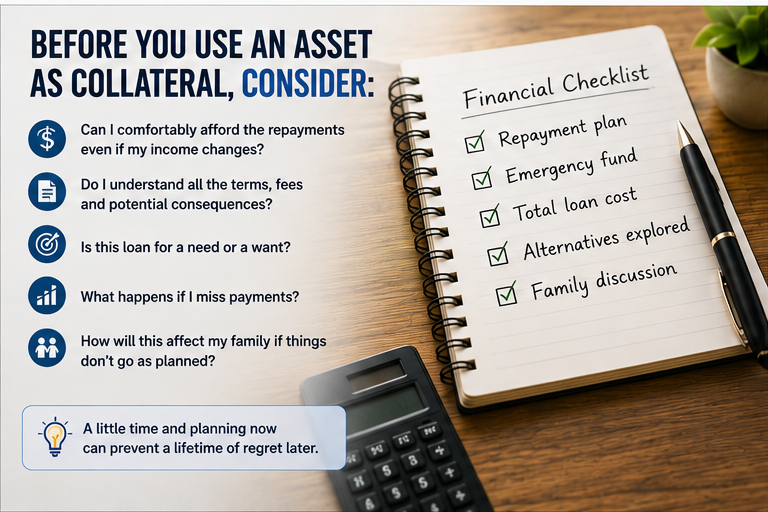
Think About What Happens When Things Don''t Go According to Plan
People generally take loans because they expect to repay them.
That''s normal.
The problem is that financial plans are made using today''s circumstances, while loans often last for months or years.
Income can change.
Businesses can struggle.
Expenses can increase.
Interest rates may change on certain types of loans.
Unexpected responsibilities can appear.
A sensible borrowing decision therefore shouldn''t depend entirely on everything going perfectly.
This is especially important when the collateral is something that would be difficult or impossible for your family to replace.
Not All Assets Carry the Same Level of Risk
There is a significant difference between putting a non-essential asset at risk and putting your family''s primary residence at risk.
For example, losing a recreational asset may be financially painful.
Losing a home can affect housing, schooling, employment, family stability and everyday life.
Similarly, using essential business equipment as collateral can be very different from using an asset that isn''t necessary for generating income.
The more important the asset is to your family''s stability, the more carefully the decision should be considered.
Understand Exactly What You''re Agreeing To
Before using an asset as collateral, the loan agreement deserves careful attention.
Understand:
- Which asset is being used as collateral
- The total amount being borrowed
- The interest rate
- The repayment schedule
- Additional fees and charges
- What constitutes a default
- What happens after missed payments
- What rights the lender has over the collateral
- Whether the interest rate can change
- What happens if you want to repay the loan early
The exact rules vary between countries, lenders and types of loans.
If the agreement is difficult to understand, getting independent financial or legal advice can be worthwhile — particularly when a home, business or other major family asset is involved.
Consider the Purpose of the Loan
The reason you''re borrowing matters.
Using secured borrowing to fund something that could generate income or support a carefully planned long-term goal is a different situation from using a valuable asset to pay for short-lived consumption.
This doesn''t automatically make one decision right and the other wrong.
It simply means the potential benefit should be weighed against what you''re putting at risk.
If the loan fails to achieve its intended purpose, the debt can remain while the collateral is still exposed.
Don''t Focus Only on the Interest Rate
A lower interest rate can make a secured loan look attractive.
But interest is only one part of the decision.
You should also consider the loan term, fees, repayment amount, flexibility and the consequences of default.
Most importantly, consider the asset being pledged.
A slightly cheaper loan isn''t necessarily a better financial decision if it exposes an essential family asset to unnecessary risk.
The cheapest borrowing option on paper isn''t always the option with the lowest overall financial risk.
There May Be Alternatives
Before using an important asset as collateral, consider whether there are other ways to address the financial need.
Depending on the situation, alternatives could include:
- Borrowing a smaller amount
- Delaying the purchase
- Saving for longer
- Negotiating the price
- Reducing other expenses
- Restructuring existing debt
- Increasing income
- Exploring different financing options
- Seeking professional financial guidance
None of these options will work for everyone.
The point is simply to avoid assuming that pledging a valuable asset is the only way forward.
Talk About Major Financial Decisions With Your Family
If the asset is important to your household, the decision shouldn''t necessarily happen in isolation.
A family home, shared investment or essential vehicle can affect everyone.
Discussing the potential consequences can help the household understand the financial commitment and prepare for it.
This is particularly important when multiple people contribute to household expenses or depend on the asset.
Financial transparency won''t eliminate risk, but it can prevent one person''s financial decision from becoming a surprise for everyone else.
Protecting an Asset Can Be More Important Than Accessing More Money
There are moments when having access to money feels like the most urgent thing in the world.
A financial emergency appears.
An opportunity comes along.
A major expense needs to be paid.
A business needs funding.
The temptation is to focus on how quickly you can obtain the money.
But sometimes the more important question is what you''re putting at risk to obtain it.
An asset that took years to build shouldn''t be treated casually simply because it gives you access to borrowing today.
Money can be borrowed again.
Some assets may be extremely difficult to replace.
The Real Cost of Collateral
The cost of a secured loan isn''t only the interest you pay.
There is also the financial risk attached to the asset.
If everything goes according to plan, you may repay the loan and retain the asset.
But if things go badly, the consequences can be much larger.
A family could lose an important source of stability.
A business could lose equipment it depends on.
A household could lose transportation.
A property could potentially be placed at risk.
That possibility doesn''t mean secured loans should never be used.
It means the collateral should be treated as part of the cost of the decision.

Borrowing Should Support Your Financial Future, Not Put It on the Line Unnecessarily
There are legitimate reasons to use secured borrowing.
For some people, it can provide access to financing that may otherwise be unavailable or more expensive.
The important part is understanding the trade-off.
You''re receiving access to money today while giving the lender security over something valuable.
That arrangement can work when the loan is affordable, the purpose is sensible and the risks are understood.
But when the collateral is an essential family asset, the standard for making that decision should be much higher.
The Bottom Line
Using an asset as collateral can make borrowing possible, but it also changes what''s at stake.
The biggest mistake is thinking about the loan only in terms of the money you''ll receive.
Think about the entire arrangement.
You''re borrowing money.
You''re agreeing to repay it.
You''re paying interest and potentially other costs.
And you''re placing an asset behind that promise.
If the asset is your home, your primary vehicle, your business equipment or something else your family depends on, the decision deserves particular care.
A loan should ideally strengthen your financial position or help you achieve a well-planned goal — not create a situation where one financial setback could put years of hard work at risk.
Before putting an important asset behind a loan, understand the agreement, understand the repayment, and understand what could happen if circumstances change.
Because protecting your family''s financial foundation can sometimes be more valuable than gaining access to more money today.