Only If We All Understood How Investments Work
Investing often feels like a world reserved for experts. It does not have to be. A plain-language look at saving versus investing, compounding, risk, fees and why financial education may be the most valuable investment of all.

There is something strange about investing.
We are constantly told that we should invest for the future. We hear about stocks, bonds, funds, property, retirement accounts, cryptocurrencies, index funds, interest, dividends, compound growth and dozens of other financial terms.
But for many people, investing still feels like something that belongs to someone else.
It can seem complicated.
It can seem risky.
And sometimes, it can feel as though everyone else received a financial instruction manual that somehow never reached you.
The truth is that investing does not have to be reserved for financial experts, wealthy people or people who spend their evenings studying financial markets.
Understanding how investments work is a skill.
And like many skills, it becomes considerably less intimidating once someone explains it properly.
Imagine what would happen if more people around the world understood what their money could potentially do over time.
Imagine if people understood the difference between saving and investing, knew why diversification matters, understood the relationship between risk and potential return, and had access to reliable tools that could help them make informed decisions.
Perhaps people would feel less intimidated by their financial future.
Perhaps more people would start earlier.
And perhaps one of the biggest barriers to investing would not be a lack of money, but simply a lack of accessible financial education.
Investing Can Sound Much More Complicated Than It Really Is
At its simplest, investing means putting money into something with the expectation that it may grow in value or generate income over time.
That is the basic idea.
The complicated part comes afterwards.
There are thousands of possible investments, different levels of risk, different fees, different time horizons, different markets and different strategies.
You might hear someone talking about individual companies and stocks one day, then hear someone else discussing bonds, mutual funds, exchange-traded funds, property or other assets the next.
It can quickly become overwhelming.
And when people do not understand something, they often avoid it.
That is completely understandable.
Most people would not walk into a complicated machine room and start pulling random levers.
Money deserves the same level of caution.
The problem is that avoiding investing altogether can also have financial consequences over a long period of time.
Saving and Investing Are Not the Same Thing
One of the first concepts people need to understand is that saving and investing serve different purposes.
Saving generally means keeping money somewhere relatively accessible and focused on preservation and short-term needs.
Investing involves accepting some level of uncertainty in pursuit of potential long-term growth or income.
Neither is automatically better than the other.
They simply have different jobs.
Money that you may need soon is generally treated differently from money that you can leave untouched for many years.
This distinction is important because one of the biggest mistakes a new investor can make is putting money into an investment without understanding when they might need it again.
Your emergency savings and your long-term investment portfolio do not necessarily need to do the same thing.
The Power of Time
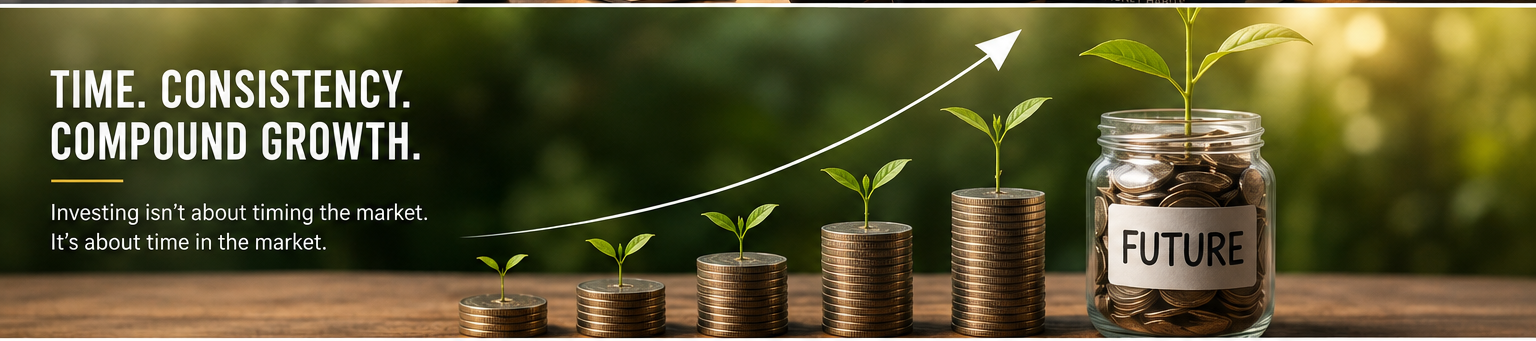
One of the most interesting things about investing is that time can become an extremely important part of the equation.
A person does not necessarily need to begin with a huge amount of money to learn about investing.
What matters is understanding the relationship between contributions, returns, time and compounding.
Compounding is essentially the process where returns can themselves generate additional returns over time.
The longer money remains invested, assuming the investment performs positively and other factors remain favourable, the more opportunity there may be for growth to build upon previous growth.
This is one reason starting early can matter.
Not because everyone needs to become wealthy.
Not because markets always go up.
And certainly not because investing guarantees a particular result.
It is because time can give an investor more opportunity to experience the long-term effects of compounding.
But Investing Is Not Magic
This part is important.
Investing is not a guaranteed shortcut to wealth.
Markets can fall.
Companies can fail.
Assets can lose value.
Economic conditions can change.
Interest rates can move.
Political events, technological changes, recessions and unexpected global events can affect financial markets.
Anyone promising guaranteed high returns with little or no risk should immediately make you cautious.
There is usually a relationship between risk and potential reward.
Generally, investments with greater potential returns can also involve greater uncertainty and the possibility of greater losses.
Understanding that relationship is far more useful than simply chasing whatever investment happens to be popular this month.
The Internet Has Changed Access to Financial Information
There has never been more financial information available to ordinary people.
You can learn about investing from educational websites, books, courses, financial publications, calculators, market data platforms and countless other resources.
But access to information does not automatically mean access to understanding.
In fact, the enormous amount of information available online can sometimes make things even more confusing.
One person says an investment is brilliant.
Another says it is terrible.
Someone predicts a market crash.
Someone else predicts a massive rally.
A social media influencer claims they found the next big opportunity.
A professional investor says the opposite.
So which one do you believe?
This is why financial education matters.
People do not simply need more information.
They need better ways to understand and evaluate information.
Imagine Having the Right Tools

Imagine being able to enter your investment amount into a simple calculator and see how different contribution levels could potentially affect your long-term results.
Imagine being able to compare different investment approaches.
Imagine having educational explanations for unfamiliar financial terms.
Imagine being able to explore different asset classes, understand their potential risks, learn how diversification works and see how fees can affect long-term outcomes.
You can start with our financial calculators, look up unfamiliar words in the finance dictionary, or map your monthly numbers with the budget planner.
Tools like these do not make investment decisions for you.
They simply make the financial world easier to understand.
And that distinction matters.
The goal should not be to tell people what they must buy.
The goal should be to give people enough knowledge and resources to make better decisions for themselves.
You Do Not Need to Understand Everything on Day One
One of the biggest psychological barriers to investing is believing that you need to understand everything before you begin learning.
You do not.
You do not need to understand every financial instrument.
You do not need to know what every market is doing.
You do not need to become an economist.
You do not even need to understand every investing strategy.
Start with the basics.
Learn what a stock is.
Learn what a bond is.
Learn what an investment fund is.
Learn what diversification means.
Learn about investment fees.
Learn about risk.
Learn about time horizons.
Learn why past performance does not guarantee future results.
Then gradually build from there.
Financial knowledge works much like learning a language.
You do not need to know every word before you can understand your first sentence.
Small Amounts Can Still Be Educational

Another misconception is that investing only becomes worthwhile when you have a large amount of money.
For someone starting out, the first investment can be valuable for another reason entirely: education.
Making a small, carefully considered investment can teach you things that a textbook sometimes cannot.
You begin to understand what market movements actually feel like.
You learn how volatility works.
You learn how you react emotionally when an investment falls.
You learn the importance of patience.
You learn why having a plan matters.
Of course, people should only invest money they can reasonably afford to put at risk, and the right approach depends on their personal circumstances.
But learning does not have to begin with a fortune.
The Biggest Investment Might Be Financial Education
There is an argument that before people invest their money, they should invest some time into understanding money itself.
Learn how income works.
Learn how expenses work.
Understand debt.
Build appropriate emergency savings.
Understand your financial goals.
Then learn how investing fits into that bigger picture.
Because an investment portfolio exists within your life.
It should not be separated from everything else.
Someone with expensive high-interest debt may have very different priorities from someone with stable finances and a long investment horizon.
Someone saving for a goal in a few months may have a completely different strategy from someone investing for several decades.
There is not one universal investment strategy that works perfectly for everyone.
What If Financial Education Were Easier to Access?
This is where things become interesting.
What if financial education was not hidden behind complicated terminology?
What if a person could ask a simple question and receive a clear explanation?
What if they could use calculators to understand compound growth?
What if they could compare different scenarios?
What if investment concepts were explained using ordinary language instead of pages of technical terminology?
What if reliable educational resources were available regardless of where someone lived or how much money they earned?
That could make a meaningful difference.
Financial technology has already made many financial services more accessible.
The next challenge is making financial understanding just as accessible.
Because giving someone access to an investment platform is one thing.
Giving them the knowledge to use it responsibly is another.
We Should Not Confuse Access With Opportunity
Having access to an investment account does not automatically mean someone has the financial ability to invest.
People have different incomes, responsibilities, debts, living costs and financial circumstances.
Some people are simply trying to make it through the month.
Others may have money available but do not know where to begin.
Others may understand investing but lack access to suitable financial products or trustworthy resources.
This is why the conversation about investing should be broader than simply saying:
"Everyone should invest."
A more useful message is:
Everyone should have the opportunity to understand how investing works.
What people choose to do with that knowledge will naturally differ.
The Goal Is Not to Make Everyone a Professional Investor
We do not need everyone to become a stock-market expert.
We do not need everyone analysing company financial statements every night.
We do not need everyone tracking markets every hour.
In fact, constantly watching investments can sometimes encourage emotional decisions.
The real goal is much simpler.
People should be able to look at an investment and understand what they are buying, why they are buying it, what risks they are accepting, what fees they are paying and what role it plays in their broader financial plan.
That is financial confidence.
And financial confidence is different from financial certainty.
Nobody can know exactly what markets will do tomorrow.
But understanding how markets work can make uncertainty much easier to navigate.
The Financial Future Belongs to the People Who Understand Their Options
The world is changing quickly.
Technology is changing how people save, invest and access financial information.
Artificial intelligence is making it easier to analyse large amounts of information.
Financial platforms are becoming increasingly accessible.
Educational resources are expanding.
But technology alone is not enough.
People still need clear explanations.
They need trustworthy information.
They need useful calculators.
They need practical examples.
They need resources that help them understand the consequences of financial decisions rather than simply encouraging them to make those decisions.
Because the most powerful financial tool may not be an investment platform.
It may be understanding.
So, Where Should Someone Begin?
Start by becoming curious.
Ask questions.
Learn the basic terminology.
Understand your own financial position.
Set goals.
Learn about risk.
Understand diversification.
Research fees.
Explore different types of investments.
Use reputable educational resources and financial calculators.
And most importantly, do not rush simply because someone online claims that you have missed the next big opportunity.
There will always be another investment opportunity.
There will always be another market trend.
There will always be another person claiming to know exactly what happens next.
You do not need to predict the future.
You need to understand your choices.
Imagine If We All Had the Knowledge
Imagine a world where a teenager could learn the basics of investing before receiving their first full-time paycheck.
Imagine a young adult understanding compound growth before spending years wondering where their money went.
Imagine families having access to simple financial tools that helped them understand long-term decisions.
Imagine people being able to distinguish between genuine investment opportunities and financial scams.
Imagine investors understanding risk before taking it.
Imagine financial education being treated as an essential life skill rather than something reserved for people studying finance.
Maybe then investing would not feel like a mysterious world reserved for people who already have money.
Maybe it would simply become another skill people could learn.
And perhaps that is the real opportunity.
Not making everyone rich.
Not guaranteeing financial success.
But giving more people the knowledge, tools and confidence to make informed decisions about their financial future.